Cute and Funny Jesus Clipart: Illustrations for Local Branding
As a brand designer who’s developed visual identities for over 40 local businesses—from artisanal coffee roasters in Portland to handmade soap studios in Asheville—I recently evaluated Cute and Funny Jesus Clipart for a real client project: a Nashville-based bakery launching a limited-edition “Holy Moly Muffins” seasonal line. My goal wasn’t just to assess aesthetics—it was to determine whether this graphic design asset could function as authentic, respectful, and commercially viable brand reinforcement across packaging, social media, and in-store visuals.
First Impression: Warm, Whimsical, and Intentionally Human
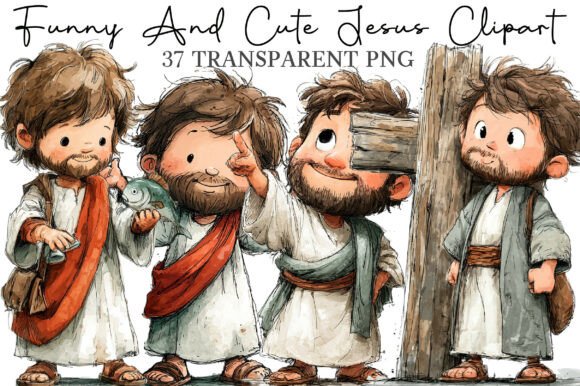
At first glance, Cute and Funny Jesus Clipart delivers soft-lined charm—not caricature, not satire, but gentle, approachable reverence with a smile. The illustrations lean into warmth: rounded features, expressive eyes, subtle halos rendered in delicate line work or soft watercolor textures. This isn’t bold gospel iconography—it’s friendly, inclusive, and quietly joyful. It suggests a brand personality that’s handmade, community-centered, and emotionally grounded—ideal for small business branding where authenticity matters more than polish.
It reads as neither premium-luxury nor mass-market. Instead, it fits naturally within organic food labels, botanical skincare packaging, local florist thank-you cards, or children’s product branding that values kindness, humility, and quiet celebration. Think: a lavender candle label with a tiny illustrated figure holding a sprig; a bakery sticker featuring a smiling figure beside a loaf of sourdough; or a boutique’s holiday gift tag with gentle gold foil accents around the illustration.
Where It Builds Real Business Value
In practice, Cute and Funny Jesus Clipart strengthens several key pillars of local business presentation:
- Stronger first impression: On crowded farmers’ market shelves or Instagram feeds, its distinctive warmth cuts through noise without shouting.
- Better product recognition: When repeated consistently across stickers, hang tags, and menu boards, it becomes a quiet signature—like the recurring motif on a beloved neighborhood café’s ceramic mugs.
- Clearer visual hierarchy: Used as a decorative accent (not dominant focal point), it frames headlines and pricing without competing—especially effective beside clean sans-serif type or warm handwritten fonts.
- More consistent brand identity: As part of a broader illustration system (paired with matching botanicals, baked goods, or seasonal motifs), it supports cohesive storytelling across touchpoints.
- Improved customer trust: Its sincerity—neither ironic nor overly solemn—resonates with audiences seeking brands aligned with compassion and everyday grace.
Smart Applications Across Local Business Touchpoints
This set shines brightest when used intentionally—not as filler, but as intentional punctuation. Here’s how it performed in real scenarios:
- Product labels: Paired with earthy kraft paper and muted olive ink, the clipart added heart to a small-batch honey jar without overwhelming ingredient lists.
- Packaging accents: A single, scaled-down illustration on the bottom corner of a soap box created instant visual cohesion with the brand’s hand-drawn logo.
- Hero graphics: Enlarged and centered on a limited-run poster for a “Bless This Brew” coffee launch—soft background, ample breathing room—felt celebratory and grounded.
- Thank-you cards & printable inserts: Printed on seeded paper for a floral subscription service, the illustration lent tenderness to a simple “Thanks for growing with us” message.
- Social media graphics: Resized and layered over real product photos in Canva templates, it elevated organic Instagram Stories without looking templated.
Where Caution Is Essential
Like any strong graphic design asset, Cute and Funny Jesus Clipart requires thoughtful placement. Avoid using it:
- In formal corporate branding contexts (e.g., law firms, financial advisors) where tone mismatch risks undermining credibility.
- On very small labels (<5mm height)—fine details like halos or facial expressions vanish, leaving only vague shapes.
- In crowded packaging layouts where text density or competing patterns dilute its impact.
- Near ingredient-heavy or regulatory text (e.g., FDA-mandated disclosures), where visual weight must prioritize clarity over charm.
- Against low-contrast backgrounds (e.g., light gray on off-white), especially if relying solely on PNG transparency.
- Within luxury minimalist brands built on stark typography and negative space—here, it disrupts rather than enhances.
Practical Designer Notes You Can’t Skip
Before committing to Cute and Funny Jesus Clipart in your next local business project, run these checks:
- Test it on real packaging mockups—not just digital previews—to gauge scale, proportion, and emotional resonance at shelf level.
- Check black-and-white usage: Does the line weight hold up in monochrome print? Crucial for cost-effective labels or newspaper ads.
- Preview it on small labels at actual size—many SVG files scale beautifully, but fine PNG details often blur.
- Test it with your brand colors: Does the warmth clash with cool-toned palettes? Does it sing alongside terracotta and cream but mute against navy?
- Compare it side-by-side with competitor packaging—does it differentiate or blend in?
- Review print quality at 300 DPI: Are edges crisp? Are halos or glows rendering cleanly?
- Inspect PNG transparency and SVG editability: Can you recolor elements or isolate parts for flexible reuse?
- Test it beside serif, sans serif, script, handwritten, and display fonts—some pairings enhance warmth; others create unintended tension.
- Confirm commercial licensing explicitly covers physical product sales, social media ads, and client-facing branding—not just personal use or digital downloads.
When used with respect, restraint, and real-world testing, Cute and Funny Jesus Clipart isn’t just another illustration—it’s a thoughtful tool for small business branding that seeks to connect, comfort, and celebrate in equal measure. For the right local business—whether baking communion bread, bottling herbal tonics, or wrapping handmade candles—it adds soul without spectacle. And in today’s saturated visual landscape, that kind of quiet resonance is rare, valuable, and deeply human.